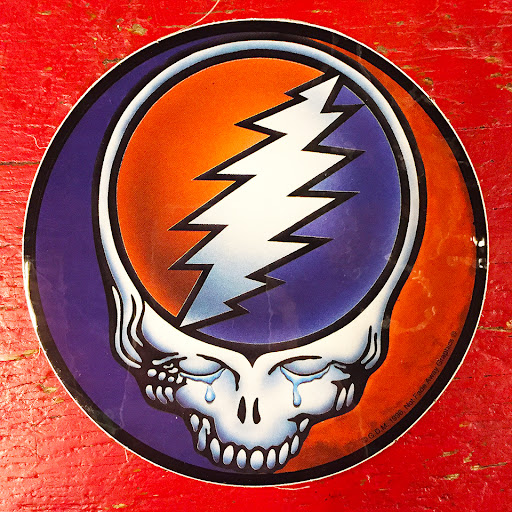
It was the era of cassettes. A guy in a chair, seated in silhouette, tie flowing behind him, told us Maxells were the best. Some people had tape-to-tape setups, sometimes you could borrow one and make copies of music for yourself and others. A simple piece of tape over the hole on top, and you were recording, helping your library grow. We just didn’t know what was out there.
Culturally, we were isolated. Despite living in a world-famous town, manufactured from whole cloth by Union Pacific to be the first destination ski resort in North America, we had remarkably little contact with what the rest of the country was doing. Star Wars didn’t make it to our theaters until nearly 6 months after its release in May, 1977. Our local FM station played Willie Nelson’s version of Me and Bobby McGee because Janis Joplin’s was a little too racy. We heard the more country-ish Eagles songs, Little River Band, and sometimes something from Glen Campbell or the theme from Davey Crockett. As far as the kind of music that a teenager of the 80’s wanted to hear, the station fell a bit short.
MTV shattered that isolation, kicking down the barriers to what happened outside of our northern Rockies sanctum. The Outside World came crashing in. In those days, MTV actually played music. It seems a trite statement in today’s world, but back then, it meant a sea change in how we heard music. Turn on your TV, turn on your stereo and tune it to something at the top of the FM dial, turn the sound on the TV off, and suddenly the box that sat in the room, with a dial for changing channels and a single speaker became a stereo wonder that showed you the latest in videos along with the coolest music the VJs had to offer.
My parents didn’t want to pay the $10 per month for cable, in today’s dollars that was over $30. They also weren’t big TV watchers, so the set was in a seldom-used room while the FM tuner with 2 speakers was in the kitchen/dining/living room in our small duplex townhouse. We were instructed to keep the volume down, lest we bother the neighbors. The house had been built before the Party Wall had been designed, so sound transited between the walls easily. Volume was kept low, except every morning at 7:35, when Paul Harvey’s commentary was broadcast on the local FM station. My father always jumped up to adjust the volume, because by coincidence, that was the exact time of day my mother needed to operate either the blender or garbage disposal. If she had a jackhammer handy, she would have run that as well.
Dad was an engineer, with a dry, subtle sense of humor, but it was also the era when a father was also shrouded in mystery, and sometimes, fear. He was self-employed, and toiled hard at his office every day, leaning over his drafting table, Mayline and triangle in constant motion, calculator nearby, mechanical pencil in hand. Stray notepads of green graph paper littered his office, along with a large bookcase spanning 2 walls. Hundreds of product catalogs, periodically updated by salesmen, covered the shelves, extra desks, floor, and any other available horizontal surface. The wedge-shaped 3-ring binders would occasionally slide, an avalance of cutsheets and specifications spilling on the floor. When obsoleted or replaced, they sometimes went to school with me. Some kids had Trapper Keepers with cool pictures; my binder said Hubbell or Allen-Bradley.
I could hear the songs on MTV, but without the cable subscription, I didn’t know the song title or artist. When visiting friends who had cable, I was mesmerized. I tried to memorize song, band, and album names, part of my ongoing campaign to be less uncool (I failed). Soundtracks of John Hughes movies intermingled with the (restrospectively) narrow playlist offered up. Those movies showed us images of high schools with long hallways with lockers on both sides, something unimaginable in my school of 140 7-12th graders; our lockers were plywood cubbies, some of which had doors. The entire concept of a high school with hundreds of kids was something that Hollywood had clearly made up. It was no more plausible than the Swedish Bikini Team in the beer ads.
The music, from The Cars and Duran Duran, to Van Halen, Huey Lewis, Tears for Fears, not to mention a steady stream of interchangable hair bands moved from MTV to our single record store to my growing cassette selection. The store was small, only a few hundred square feet, and had the 4 categories of music that existed: rock, jazz, country, and classical. I saved my money, then spent hours flipping through the meager stacks, agonizing about the single cassette I could afford. In today’s money, that cassette was about $35-40, which was a princely sum. As a result, most of my music collection was on tapes that said Maxell. I preferred the 90-minute version, where 2 full albums would fit on a single tape.
In the classroom of a favorite science teacher, two small paintings hung above the chalkboard: a portrait of The Grinch (his personal role model), and a lyric: Drivin’ That Train, High on Cocaine. I had a sense of the origin of the lyric, I had heard the song once or twice and had certainly heard the name of the band. I had also seen in Rolling Stone that they were always listed as they highest-grossing concerts in the monthly-published fine print in the magazine.
Although I knew by heart every song played on MTV, and I had my requisite copies of Synchronicity and Brothers in Arms, as every kid of the 80’s did, one day at the record store I found myself in the G section, under the small hanging sign that said ROCK. A cassette, the lone offering from one of the few bands in this section caught my eye: American Beauty. On a whim, I bought it.
At the time, my stereo system consisted of a Panasonic boom box I hung from the crank handles of a pair of casement windows in my room. I put the new tape in and pressed PLAY. I wasn’t sure what to expect, but Box of Rain captured me immediately. The tape was played in constant rotation for weeks, moving from my room to my car (now with a super-cool auto reverse tape deck, saving me the chore of ejecting and flipping the tape).
As is traditional for teenagers and parents, we worked diligently at not seeing eye-to-eye with each other. I pushed boundaries in all directions, which had a benefit to my sister: I had softened my parents up enough through my high school years that she had a near free reign when it was her turn. They were simply exhausted by my shenanigans, and by the time I was off to college, rather than watching the clock approach curfew, they would roll over and pull the covers over their heads. You’re welcome.
Living on a cultural island of 83,500 square miles and fewer than a million people, we had little knowledge or understanding of the Grateful Dead. I’d seen the cover of Wolfe’s The Electric Kool Aid Acid Test, but I was reading Fear and Loathing in Las Vegas and never got around to it. One Flew Over the Cuckoo’s Nest was required reading in 8th grade, but I never dug deeper into his catalog. I listened to my copy of American Beauty, but knew nothing of tours, bootleg tapes, or the culture that surrounded the Dead. I just knew good music when I heard it.
As digital music made its appearance, I saved even more to build a collection of CDs. In today’s money, a single CD was close to $65, so each purchase required significantly more consideration. There were no debit cards, I wasn’t going to write a check, and I certainly didn’t have a credit card of my own, so I peeled some bills out of my stash and headed to the store. The money burned a hole in my pocket, but I really didn’t have a specific album in mind. I just wanted some music.
Flip. Flip. Flip. Flip. There was a technique to fliplling through cassettes and CDs, secure in their theft-proof trays.
Flip. Flip. Flip. Flip. Pause. Consider. Flip. Flip. Flip. Rock: A. Flip. Flip. B. Flip. Flip.
Rock: G. Flip. Flip. Pause. Workingman’s Dead. Pause. Flip. Pause. Flip Back. Pause. Consider.
Purchase.
My tiny collection of CDs consisted of a small handful of titles, mostly jazz classics (Brubeck, Davis, Gillespie, Getz). If I had to spend that much on music, it had better be good and not go out of style over a short mountain summer. I put the disc into my player, a small top-opener plugged into my new rig: a big block with dual cassette, AM/FM tuner, and turntable all in one, purchased at the drug store (which also carried camping gear, tools, cameras, ammunition, and basically everything but fresh vegetables). The music poured over me, as with American Beauty I didn’t know what to expect. I loved it instantly, and it stayed in the player for weeks. Conversely, my father listened to Marty Robbins, Hank Williams, Conway Twitty, Burl Ives, and more that we referred to as “rotgut country”. Our tastes in music did not align, to say the least.
One afternoon my father walked past my room, then stopped, and turned around. I looked up, expecting that he had dropped by simply to discuss my latest infraction of The Rules (a dynamic and undefined list, designed for an element of surprise on my part and satisfaction on his). Instead, he was quiet for a moment, then asked, “What’s this music?”
“It’s the Grateful Dead, Dad.” He was quiet, listening intently for a few more moments.
“How about you make me a tape of that?” It took me several moments to pick my jaw up off the floor, but I peeled the wrapper off a new Maxell UDS II-90 (the finest) and put Workingman’s on one side and Beauty on the other. Against all odds of teenager and parent interactions, a connection had been made. The country-ish feel of the music broke a barrier between us, and a path to communication opened. I bought more CDs, made more copies, and when I would drop by his office, it was becoming common to hear Jerry or Bob’s voice on his small stereo. He would never buy his own Grateful Dead album, so I was his connection, his supply of copies of my own growing collection. The music of Barlow & Weir, Hunter & Garcia had broadened his horizons, and made a connection between his tastes and mine.
Time passed. I went to college, graduated, moved to a big city, then a bigger one, then a smaller one. Over that period I saw Phish many times, starting in the dining hall of my college with fewer than 300 people in the audience, and culminating at The Gorge with 25,000 people. The Dead were rumored to be planning a show in our small valley, but it never materialized. They never got any closer than Park City, and I couldn’t go due to other commitments. For a million reasons, I never made it to a Grateful Dead show until 1991 at Boston Garden.
But that doesn’t mean I didn’t love the music or stop listening. Or sharing tapes with my father. On visits home, I’d drop by his office and he’d have something playing softly, usually one of the two albums I had first copied for him.
In 1995, I was going to climb and ski Mt. Shasta over Memorial Day weekend. Uncle Crusty (see his bike reviews here and here), called me, saying the Grateful Dead were coming to Portland, and I should come up for the show. The climb was a paid trip, one I had saved and trained for, so I declined. “You should take my Dad,” I said. There was a pause, a chuckle, and Crusty said, “OK”. He bought tickets, I called my mom, and she laughed and agreed to come to Portland. It would be a surprise for his birthday, which was only a few days before Memorial Day that year.
They climbed in his truck and made the 8-hour drive west. My mother, who was no great fan of music, dutifully played the collection of tapes I had given him for the entire trip. I’m sure she did her level best to ignore the music, paying only enough attention to change the tapes as he drove. Periodically she would ask if he had figured out the surprise that waited for him, but he would reply that he was at a loss. He was a damn good engineer, smart, clever, and creative, but sometimes subtlety escaped him. He stayed in the dark until he was handed the tickets over dinner that evening.
The show the next day was a brand new experience for him. Uncle Crusty managed to keep him from buying several brownies and found him a safer snack, and they sat on the grass and listened to the music. There is a photo, scanned from film, that shows him with a bemused expression on his face. His dry personality meant that he would not let it slip that he was really enjoying the entire experience, but when I asked him about it later, he said that he had a lot of fun.
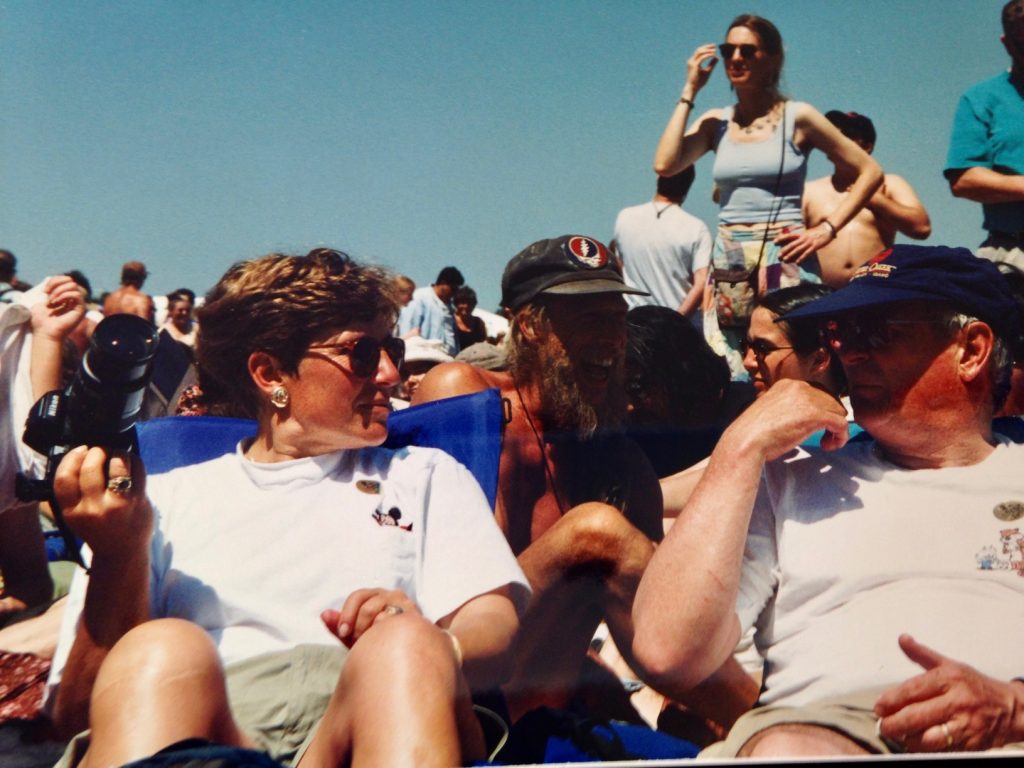
Barely 3 months later, he called me, saying that he was sorry to hear that Jerry had died. He called because he knew I loved the music, but I think it was because he truly was sorry. He listened to them, had been to a show, and while he wasn’t really On the Bus, he understood it. He had been in Palo Alto as a student in the late 1950s and early 60s, listened to the folk scene and had been to several of the cafes, bars and clubs mentioned in Phil’s autobiography. It’s entirely possible he had unknowingly heard Jerry play in his earliest days, long before Mother McCree.
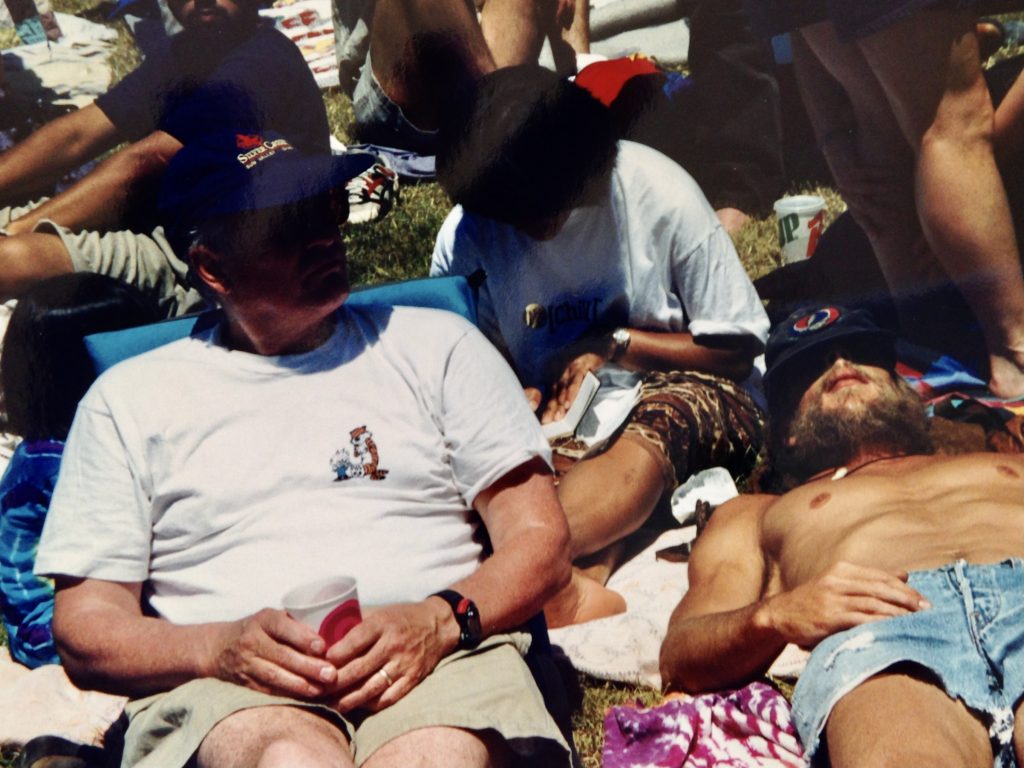
I think he liked the music based on country aspect, the part that Bob Weir brought to the band. He had heard them play Big River, Me & My Uncle, Mama Tried, Big Iron, Sugar Magnolia, Mexicali Blues, and more on the tapes I had provided, but I’m sure the engineer in him preferred the clean sound of the studio albums over the concert tapes. Those songs, brought to the fold by Bobby’s influence, had made a connection between us at the time when we were most at odds with one another, and that connection stayed for many years.
Phil’s Box of Rain always brings tears to my eyes, particularly after my father died in 2021. And while that song touches me deeply and reminds me how much I miss my father, nearly every other song in the Grateful Dead’s legacy reminds me of our shared appreciation for the music. Bob’s love of country music built the bridge between us, and helped our relationship move far beyond parent and child, to friends, companions, and people who enjoyed each other’s company and conversations.
When he saw that show, he was just a bit older than I am now. You could paste my face into that photo and struggle to determine which of us is there. In retrospect, climbing Shasta that weekend was probably the wrong choice, but at the time the Grateful Dead would always play, my parents were still young and healthy, and the future was a concept that required little attention. I have a photo, a few stories from Uncle Crusty, and a pang of regret for yet another moment missed with my father.
As a parent myself, the lyrics of Cassidy have always been something meant for my own child, who was almost given that name. While my son is no Deadhead, he has seen a show at Sphere and has (somewhat) patiently listened with me. In time, he may find his own way deeper into the music, as an excellent guitar player himself, he can understand the music far deeper than I can, assuming he listens a bit more closely someday. Let the words be yours, I’m done with mine.
Jerry, Bob, Phil, Pigpen, Keith, Brent, and Donna have all left us, but the music and their legacy is beyond the band. It’s touched countless people around the world, become a genre unto itself, and created history, culture, technology, and more. While we’ve lost the artists, the music is forever. It carries forward, manifested in every band that picks up one of the songs, from Dead & Co to DSO to neighborhood kids in a garage. No longer just music for a weird bunch of hippies, the songs have become standards, played and interpreted over and over in uncountable styles. The music has shaped generations, crossed cultures and societies, and it will go forever, never to be silenced. It is a gift to everyone who listens, in their own way, and in their own journey of understanding it.
Fare Thee Well.