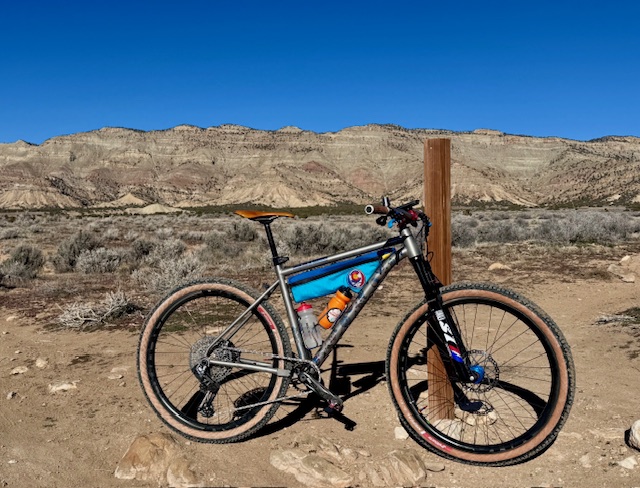
2025 became the year of the drop-bar 29er, and I was firmly on board. The feel of underbiking on a singletrack trail that has been made boring by modern full suspension mountain bikes brings back the sensations of when I first started on knobby tires. Riding my gravel bike on the edge of control on twisty singletrack reminds me of mis-spent afternoons in 1983 on my Ross “mountain bike”, which in retrospect was a beach cruiser sold to unsuspecting 14-year-olds as a budget Stumpjumper. In those days, the only place to buy a Stumpy was in the Sharper Image mail-order catalog, for about $600. The Ross was a bit under $300, and my pay working summers for a landscaper put the Stumpjumper well out of reach. 1983’s minimum wage didn’t go all that far.
As I worked through the design process in the summer and fall of 2024, I wasn’t trying to follow a trend, I was trying to take the underbiking up a notch into the world of hardtails. I’ve always found that I’m quite comfortable on drop bars in the dirt, and with the D1 design of the Force AXS levers, the high pommels mean I never actually need to get into the drops unless things get really sketchy.
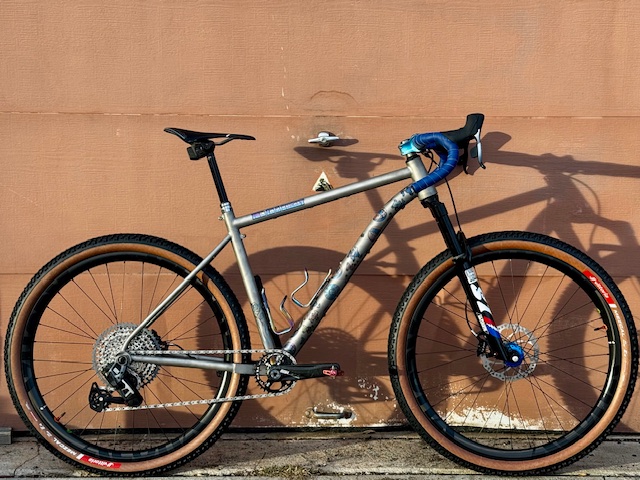
I was trying to get into the geometry of post-pandemic XC-race hardtails, with the toptube shortened a bit to account for the extra reach of drop bars, and with a 120mm SID Ultimate I had onhand. I steepend the seat tube, slackened the head tube, and basically moved the bike underneath the dimensions of my known contact points. I raised the bottom bracket a bit as well, partly for pedal clearance, and partly to make the front end easier to lift from the hoods.
All of this made for a fun, lively bike that was very playful in carved, flowy turns, and without trying to, I was setting PBs on singletrack descents. It was fun, but something was somewhat off. I was having fun, grinning, getting slightly scared, but couldn’t quite place what was holding it back from my goal. The bike got plenty of miles in lots of terrain and conditions, from 12-Hours of Mesa Verde at Phil’s World in Cortez, CO, to local trails in the Roaring Fork Valley, and laps around 18 Road in Fruita. In that time, I only crashed once, but that was due to soft trail edges and poor aim, and had nothing to do with handlebar configurations. That quick deceleration left me with an iPhone-sized purple rectangle on my hip. They don’t feel all that large when held against an ear, but seeing that outline on the side of your ass brings home a realization of how large modern phones have grown.
With the addition of a bolt-on topetube bag made by Rocky Mountain Rider, the bike was complete and ready to go. The bag attaches with Fidlock studs and receptacles, easily sourced from several stores on Etsy. It attaches and removes in a second or two, and is rock solid on the trail.
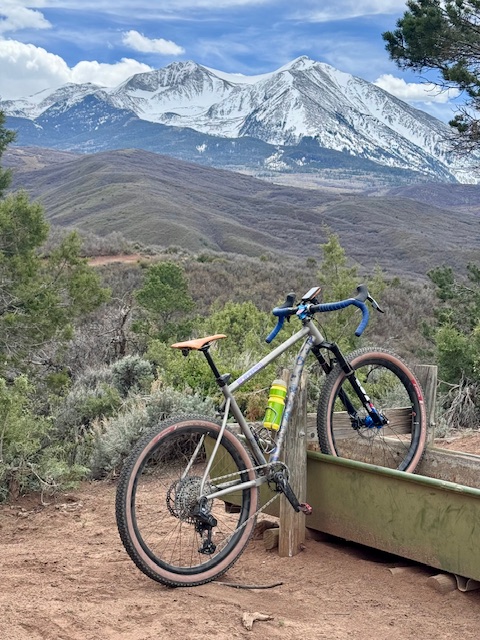
The original Spank handlebars I selected felt good, but with the 31.8mm diameter going all the way to the corners, they are remarkably stiff. Even with the SID doing bump duty, the vibration damping that the fork misses was translated directly into the web of my thumb. Numbness and blisters led me to search a flexier bar, and I switched to the Redshift Kitchen Sink. It is slightly narrower at the tops, but has a nice, wide flare, and comes with tape-on pads that give a flat spot for the heels of your hands. It tapers more quickly than the Spank, but still doesn’t have the flex of the FSA carbon gravel bars. Their flat tops give enough flex that much of the buzz is removed. While I am extremely fond of these bars, I wanted to go as wide as possible for this bike, and their widest is 480mm. The Spank, Redshift, and Curve Walmer bars are the widest I could find, and while the Curve look to be an overgrown version of the FSA, I was hesitant to spent $300 plus whatever the Tariff du Jour the Orangutan in the White House was cooking up.
I started off with a gen 1 RockShox AXS Reverb seatpost (the original, with the battery under the saddle), but as soon as possible, I replaced it with a gen 2. The newer version allows for a bit of travel when it’s dropped just a tiny bit from the top, thereby giving a bit of softtail function. This is the same as the function of the 27.2 gravel AXS Reverb post. When I raise the post up, I then give a tiny drop, which results in about 1/2″ of motion in the post. It’s not noticeable when pedaling, but when the post is all the way up, the firmness is immediately apparent. The gen 1 seatpost moved over to my full suspension frame, where it works flawlessly, even without the soft-tail effect (clearly not needed on a full-susser).
A buddy who works at Revel Bikes had given me a (now discontinued) Why titanium riser bar, and it was sitting on the bench, gathering dust. One afternoon I pulled the drop bars off, tossed on an older pair of brakes I had stashed in a box, and headed out to try the bike with mountain bike bars.
Almost immediately, I realized why I felt something was “off”. It wasn’t that Drop Bar 29ers are a bad idea (Debatable. -Ed.), but more that I had tried to make a more singletrack-friendly gravel bike and I had instead made an unbelieveably good hardtail mountain bike. My goal had been to up the underbiking fun factor, but instead I had a capable mountain bike that accelerated out of corners, was quick and lively side-to-side in twisty sections, and climbed like a beast, both in and out of the saddle. In essence, I had made it too much of a mountain bike to be fun with drop bars.
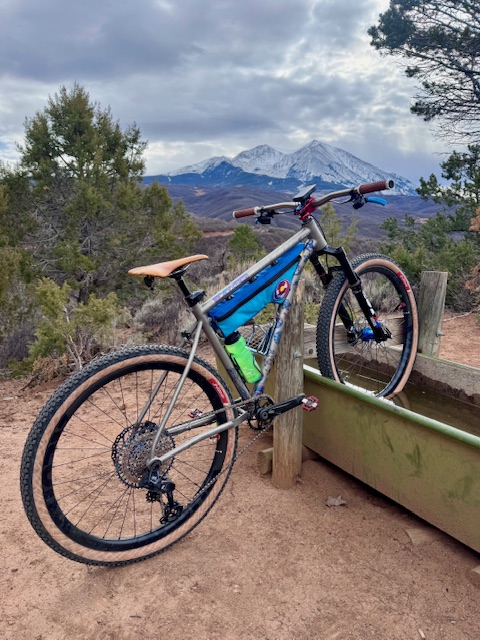
In retropsect, one thing I noticed was that most of the drop bar 29ers that popped up in 2024 and 2025 were shifted much more to the gravel end of the geometry range rather than the mountain bike end. Most had 71 or 70-degree head tubes, while I had gone with 68. I already have a 71-degree head tube on my 2017-designed gravel bike (based strongly on the original Ibis Hakkalugi with changes to match my fit). Since I was already riding what many were designing, with the exception of a rigid fork, I wanted to push it farther and get into more progressive geometry with a longer top tube and slacker head tube. I even kept in the back of my mind the Wolftooth Geoshift headset, which offers 1 or 2-degree additional tilt, should I want to slacken the headtube. It’s still an option, but I need to spend much more time with the flatbars before I make any decision. So far, though, I’m very happy with 68 degrees.
With about 100 singletrack miles behind me on flat bars, I have found what I was searching: a fun, capable hardtail for flowy trails. On this bike I’ve climbed trail sections I’ve never cleaned before, and found myself descending confidently over chunky, steep sections. One distinctly noticeable item is that the frame “unloads” like a ski when exiting a compressive turn- as it comes out of the turn it has a subtle but lively rebound feel. Most likely, this is due to 16mm seatstays and the magic flexibility of titanium.
I’ll leave the excitement and horror of underbiking to the gravel bike, which itself is a superbly fun bike in the chunky stuff. However, for days when I want to go play on singletrack, lean over in flowy turns, or survive to the top of a nasty climb, this bike will be the first choice.